Pages

Sunday, June 9, 2013

Citrus and Basil Sangria

We had dinner at Foodie’s house last week and she made the most delicious chicken marinated in coconut milk and a bunch of other stuff…so good, as usual.   BUT, I was immediately charmed and distracted by the opening act, a mouth-watering drink that sat in a serving tray on her counter suggesting that our little group would be the lucky recipients of the colorful concoction.

She made Citrus and Basil Sangria from the blog “What’s Gaby Cooking.”  In the post, the blogger explains how she is experimenting with drinks to be served at her impending nuptials and this drink is one of the contenders.

So, I’m reading through the recipe and I asked myself “what the hell is Cara Cara?”  My extensive research a google search reveals that Cara Cara is a type of seedless navel orange grown in California's San Joaquin Valley.  They have a familiar orange skin, but the meat of the orange is a beautiful pinkish red and is delightfully sweet with a hint of cranberry zing.  The name comes from where the orange was first discovered at Hacienda Cara Cara in Venezuela.  I tried to find these little lovelies in several stores but to no avail, but I found a photo on google images.  

As you can see, this recipe calls for two different types of oranges, as well as a lemon, a tangelo, the juice of a tangerine and blood orange soda – San Pellegrino makes a tasty version – so this drink is a citrus explosion.  If you can’t find or don’t have the specific varieties, any citrus fruit will do, but do not skip the strawberries….they add a nice flavor and make the drink so pretty!

Citrus and Basil Sangria
Ingredients
1/4 cup water
1/4 cup sugar
10 basil leaves
1 bottle sauvignon blanc
1 blood orange, sliced into thin rounds
1 Cara Cara, sliced into thin rounds
1 tangelo, sliced into thin rounds
1 handful strawberries, sliced
1 lemon, skin peeled into strips and added - save juice for another use
1/4 cup brandy
1 cup blood orange Italian soda
1/4 cup tangerine juice

In a small saucepan combine the water and sugar over high heat. Bring the mixture to a boil and stir until the sugar is dissolved. Turn the heat off and add the basil leaves. Stir the simple syrup to combine and let the basil leaves sit for 20 minutes while the mixture cools.  Meanwhile, in a large pitcher, combine the white wine, Italian soda, citrus slices, strawberries, lemon skin, brandy and tangerine juice. Stir to combine. Add the cooled basil simple syrup and stir. Let the sangria sit for about 1 hour and then serve over ice.

This is a perfect and pretty drink for summer get-togethers.  Be careful, though, don’t let all that fruit fool you….it packs a nice punch!

Sunday, June 2, 2013

Saffron Chicken & Herb Salad


First, dear readers, my extreme apologies for being so far behind in my posts….it’s been an unusual couple of weeks – some happy and some sad events, but all cherished memories.  I traveled to Cape Cod over Memorial Day weekend and I will write about that later.

Anyway, two Wednesdays ago, we had dinner at Singer’s house and she made another delicious dish from the Jerusalem cookbook…I think we all have a copy of that book now (although mine is on my jazzy new iPad mini but I wish I had the book...it's really beautiful).  The recipe she made, Saffron Chicken & Herb Salad, calls for boiling a whole orange, reducing it to a paste and pouring it over grilled chicken.  This reduction method produces an intense citrus flavor and just a touch will add a little zip to pork, fish as well as poultry, salsa or even cake.  The saffron and orange combination creates a colorful dish that is both bitter sweet – because of the orange – and earthy – courtesy of the saffron.  Our taste buds were doing a little dance!

Saffron Chicken & Herb Salad
From:  Jerusalem Cookbook

1 large orange
2 ½ tablespoons honey
1 tablespoon white wine vinegar
1 ¼ cups water
2 ¼ lbs boneless, skinless chicken breasts
4 tablespoons olive oil
2 small fennel bulbs, thinly sliced
1 cup fresh cilantro leaves
2/3 cup fresh basil leaves, torn
15 fresh mint leaves, torn
2 tablespoons freshly squeezed lemon juice
1 red chile, thinly sliced
1 clove garlic, crushed
Sea salt and freshly ground pepper

Preheat the oven to 400°.  Trim and discard 3/8 inch off of the top and bottom of the orange and cut it into 12 wedges, retaining the skim and discarding the seeds.  Place the orange wedges, honey, saffron, vinegar, and just enough water to cover the oranges in a small saucepan.  Bring to a boil then reduce heat and simmer gently for an hour.  At that point, you should have soft oranges and about 3 tablespoons of thick syrup.  Add water during the cooking process if the liquid gets too low.  Use a food processor to “blitz” the orange an syrup in a smooth, runny paste adding a little water if needed.

Mix the chicken breasts with half the olive oil and plenty of salt and pepper and grill on each side until dark char marks appear.  Transfer the chicken to a roasting pan and place in the oven for 20 minutes.  Once the chicken is cool enough to handle, tear it into rough, large pieces.  Place the pieces in a mixing bowl, pour half the orange paste over the chicken and incorporate well.  Save the other half of the paste for another dish…it will last in the fridge for a couple of days.  Add the remaining ingredients to the salad, including the rest of the olive oil and toss gently.  Singer served this moist and flavorful chicken on top of a bed of greens from her garden.
 
 
We had a lovely evening hanging out under the wisteria-laced arbor!

Sunday, May 19, 2013

Mutabbaq

So as I was paging through (I guess it is not really paging through when your cookbook is on your iPad, perhaps swiping through?) the Jerusalem Cookbook on my fabulous new iPad mini, I came across these little gems:

 
It was my turn to bring dessert a few Wednesdays ago, so I decided to make it.

I didn’t quite know what it was but I did know that it was in the “sweets” section and it contained some type of creamy cheese and – in my opinion – that made it instantly good.  Reading on, it is a popular crispy confection called mutabbaq and the authors explain that it is sold in a pastry shop, under an Ethiopian church, in a gloomy room, at the bottom of a stairway, in Jerusalem.

Of course, in the original recipe, the filo dough is made by hand – complete with all the pulling and stretching histrionics involved – I just opened the door in the freezer section of the grocery store, stretched and pulled out a box of filo dough.  My former husband would often tell a story about his grandmother, mother and aunts spending an entire day making cheery strudel, recalling a similar dough making and stretching memory where they filled the confection with freshly picked cherries from the back yard. He said it was the best strudel he ever tasted. Even though opening the box was not as labor intensive (or perhaps gratifying) as making fresh filo dough, I would say that the results were just as satisfying.  This dessert prompted the comment… “We’ve had many delicious desserts, but this is the best by far.”

Mutabbaq
From: Jerusalem Cookbook

For the pastry
2/3 cup unsalted butter, melted
14 sheets filo pastry
2 cups ricotta cheese
9 oz goat cheese
2 Tablespoons freshly grated lemon zest (my addition)…orange would be nice too!
Chopped pistachios (unsalted)

For the syrup
6 tablespoons water
1 1/3 cup superfine sugar
3 Tablespoons freshly squeezed lemon juice…or orange juice

Heat the oven to 450°.  Mix the ricotta, goat cheese and lemon zest in a bowl and set aside.  Brush a baking sheet with some of the butter. Place a sheet of filo dough on and brush with some more butter.  Continue this step – brushing with butter between each layer – until 7 sheets of filo dough have been layered.  Spread the cheese mixture over the filo, leaving a ¾” edge.  Layer the remaining filo using the same layer-butter method.  Tuck edges underneath the pastry and brush with more butter.  Using a sharp knife, score the pastry into six even squares (do not cut all the way through).   
Also, score each newly formed square – only until you hit the cheese layer – with a “+” sign. I forgot this step but it makes for a nice presentation. Bake for 25 minutes, until crisp and golden. 

While the pastry is baking, prepare the syrup by placing the water and sugar in a pan over a medium heat.  Stir well and bring to a boil, add the juice and simmer for 2 minutes.  Set aside. When the pastry comes out of the oven, pour the syrup over the pastry and top with pistachios.  Serve warm.

This is so tasty…not waistline friendly, but incredibly good.       

Saturday, May 18, 2013

Stella

Today, Stella would have been 13. Stella died on Wednesday, May 8, 2013. I came home from work and found her lying peacefully on my bedroom floor, just like she was sleeping. The vet told me that she likely felt a little strange, fell asleep, then passed away. She is my Boston angel now and I know she continues to protect and watch over me from the big playground in the sky.  She puts a smile on my face everyday.

Below is the post I wrote about Stella when I found out she was sick and I re-post to celebrate the birthday of a great dog. Rest peacefully my little friend.  I will miss you.  I know that a star -- the meaning of your name in Italian -- will shine a little brighter because of you.

A friend of mine recommended I read a children's book, Dog Heaven by Cynthia Rylant after Stella died.  It is a sweet, beautifully illustrated book that is sure to comfort both children and adults who experience the loss of a beloved pet..at least this adult.

Original post from July 2012

Lessons Learned From The Wild Ones

Recently the vet diagnosed my Boston Terrier, Stella, with advanced heart disease. She collapsed one day doing what dogs do….protecting her house and humans from intruders – the trash collectors. She was indoors and the interlopers were never in any real danger because of the structural barriers but, nonetheless, Stella was going to make her presence known and bark her disapproval.

I wonder if Stella has any clue about what's happening in her little body. All she knows is that now she gets a peanut butter-smothered pill two times a day and Mommy is feeding toast each morning…it doesn’t matter to her that the toast is meant to fill her tummy so the medicine doesn’t make her sick. Her unconscious resilience and ability to go about her day – happy and unfettered by the consequences of the diagnosis (despite her labored breathing) – has reminded me to embrace and enjoy her each day.

She still wags her tail (which is really a stump) when she sees people that – to her – could have been gone for five years, five months, five weeks, five days, or five minutes…it doesn’t matter, she is still happy to see them, regardless of why she hasn’t in a while. People come in and out of our lives for various reasons and circumstances so when you see them again, make like a dog, wag your tail and blissfully greet them. Stella still chases squirrels and birds that she will never catch, undeterred, moving merrily on to the next potential conquest. This is a reminder to never give up chasing a dream.   Stella stretches every morning before she gets out of bed and even though my yoga teacher has preached for years the value of a morning stretch ritual, it took my canine companion to finally help the nickel drop for me.  

The lessons we can learn from our pets are endless and enduring and go way beyond the love and loyalty that our beastly companions offer each day. Observe and love them and I suspect that life will quickly become a little less complicated and way more gratifying.

Monday, May 6, 2013

Saffron Rice Pilaf


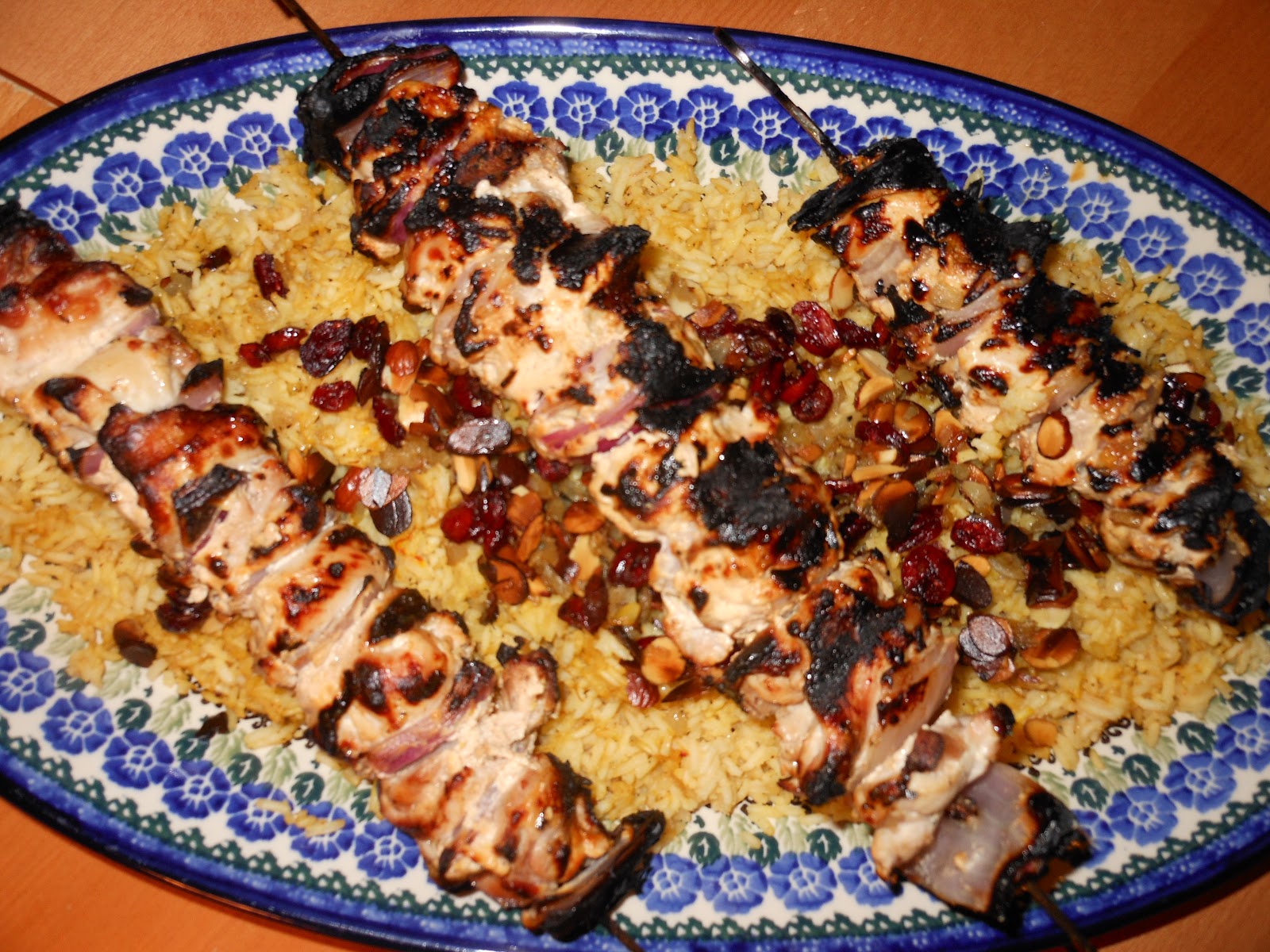
Continuing with our dinners paying tribute to middle-eastern cuisine, Architect made Saffron Rice Pilaf with Chicken Kabobs.

Saffron is a colorful spice plucked from the flower of the saffron crocus. Saffron is from the Arab word for yellow, zafaran, and yellow symbolized joy for the Arabs.  Pharaohs and kings believed that saffron was an aphrodisiac, and when the expected results were futile, saffron’s fever reducing and nerve calming medicinal benefits remained.

This dish is made with delicious basmati rice complemented by equally delicious and always pleasing caramelized onions.

Saffron Rice Pilaf
Epicurious.com

¾ teaspoon crumbled saffron threads
2 tablespoon boiling-hot water
1/3 cup olive oil
1 cup slivered almonds
1 very large onion, chopped
1 ½ cup of basmati rice
2 ¼ cups of water
1 ½ teaspoons salt
½ teaspoon pepper
1 cup of dried currents, raisins or cranberries

Soften saffron in hot water in a small bowl. Heat oil in a 5-quart heavy pot over medium-high heat until it shimmers.  Fry almonds, stirring frequently until golden, about 3 minutes.  Transfer with a slotted spoon to paper towels to train.  Fry onion in remaining oil in pot, stirring occasionally, until golden brown, 15-20 minutes.  Transfer half of onions to a bowl. 
Add rice to onion in pot and sauté, stirring, until fragrant, about 2 minutes.  Add water, saffron mixture, salt, pepper and bring to a simmer.  Reduce heat to low and cook, covered, until water is absorbed and rice is tender, 18-20 minutes.  Let rice stand, off heat, for 5 minutes.  While rice stands, stir almonds and fruit into bowl with the reserved onion.  Fluff rice with a fork and serve with almond mixture spooned on top. 

Architect served the pilaf topped with barbequed chicken and onion kabobs.   Foodie made a salad from The Jerusalem cookbook, Baby Spinach Salad with Dates, Almonds & Pita Bits. Life. Is. Good.